This is default featured slide 1 title

Go to Blogger edit html and find these sentences.Now replace these sentences with your own descriptions.

This is default featured slide 2 title

Go to Blogger edit html and find these sentences.Now replace these sentences with your own descriptions.

This is default featured slide 3 title

Go to Blogger edit html and find these sentences.Now replace these sentences with your own descriptions.

This is default featured slide 4 title

Go to Blogger edit html and find these sentences.Now replace these sentences with your own descriptions.

This is default featured slide 5 title

Go to Blogger edit html and find these sentences.Now replace these sentences with your own descriptions.

Tuesday, April 24, 2018

Time to celebrate the 2018 Google Play Award nominees

Posted by Purnima Kochikar, Director, Apps and Games Business Development, Google Play

2018 Google Play Awards

This year's Google Play Awards will take place on Monday, May 7th, kicking off the week of Google I/O. Celebrating our third year, we're excited to highlight nine categories; some you may recognize from previous years, along with new additions highlighting growth areas and trends we're focused on, such as building for emerging markets.

Each year, the Google Play Awards recognize top apps and games on Google Play. They represent some of the best experiences available on Android, with an emphasis on overall quality, strong design, technical performance, and innovation. The nominees were selected by various teams across Google, and all meet criteria thresholds covering high star rating, Android vitals, and have had a launch or major update since April 2017.

Congratulations to this year's nominees below and don't forget to check them out on the Google Play store at g.co/play/gpa2018.

Standout Well-Being App: Clue, Fabulous, Headspace, Lifesum, Simple Habit

Standout Well-Being App

Apps empowering people to live the best version of their lives, while demonstrating responsible design and engagement strategies

Best Accessibility Experience: Audio Game Hub, Be My Eyes, Open Sesame, Universal Copy, Voice Volume Catcher

Best Accessibility Experience

Apps or games enabling device interaction in an innovative way that serves people with disabilities or special needs

Best Social Impact: Forest, Khan Academy, Otsimo, Tala, TODXS

Best Social Impact

Apps or games that create a positive impact in communities around the world (focused on health, education, crisis response, refugees, financial health & fundraising functions)

Standout Indie: Agent A, Bridge Constructor Portal, Flipping Legend, Old Man’s Journey, OPUS: Rocket of Whispers

Standout Indie

Games from indie developers that focus on artistic design, gameplay mechanics, and overall polish

Best Community Building Game: Clash Royale, Lineage 2: Revolution, Pokémon GO, PUBG MOBILE

Best Community Building Game

Games built to connect gamers, encouraging social interaction and community building

Best AR or VR Experience: ASTEROIDS!, BBC Earth: Life in VR, Brickscape, Figment AR, Porsche Mission E

Best AR or VR Experience

Apps or games offering highly engaging and immersive experiences with optimal use of ARCore or Daydream UI

Standout Build for Billions Experience: Cricbuzz, Flipkart, Mercado Libre, Moovit, Viki

Standout Build for Billions Experience

Apps or games with optimized performance, localization, and culturalization for emerging markets

Standout Startup: Astro, Canva, Drops, Kredivo, N26

Standout Startup

Apps from new developers that offer a unique experience while achieving strong organic install growth.

Best Breakthrough Hit: Animal Crossing: Pocket Camp, Cooking Craze, Empires & Puzzles, Final Fantasy XV Pocket Edition, PUBG MOBILE

Best Breakthrough Hit

New apps or games with excellent overall design, user experience, engagement and retention, and strong organic install growth

Come back on Monday, May 7th when we announce the winners, and until then, make sure to try out some of these great apps and games on Google Play at g.co/play/gpa2018.

How useful did you find this blogpost?

Tuesday, April 17, 2018

Protecting WebView with Safe Browsing


Posted by Nate Fischer, Software Engineer


Since 2007, Google Safe Browsing has been protecting users across the web from phishing and malware attacks. It protects over three billion devices from an increasing number of threats, now also including unwanted software across desktop and mobile platforms. Today, we're announcing that Google Play Protect is bringing Safe Browsing to WebView by default, starting in April 2018 with the release of WebView 66.


Developers of Android apps using WebView no longer have to make any changes to benefit from this protection. Safe Browsing in WebView has been available since Android 8.0 (API level 26), using the same underlying technology as Chrome on Android. When Safe Browsing is triggered, the app will present a warning and receive a network error. Apps built for API level 27 and above can customize this behavior with new APIs for Safe Browsing.


An example of a warning shown when Safe Browsing detects a dangerous site. The style and content of the warning will vary depending on the size of the WebView.


You can learn more about customizing and controlling Safe Browsing in the Android API documentation, and you can test your application today by visiting the Safe Browsing test URL (chrome://safe-browsing/match?type=malware) while using the current WebView beta.

Monday, April 16, 2018

Android Things Release Candidate


Posted by Dave Smith, Developer Advocate for IoT


Earlier this year at CES, we showcased consumer products powered by Android Things from partners like Lenovo, LG, JBL, iHome, and Sony. We are excited to see Android Things enable the wider developer ecosystem as well. Today we are announcing the final preview release of Android Things, Developer Preview 8, before the upcoming stable release.


Feature complete SDK


Developer Preview 8 represents the final API surface exposed in the Android Things support library for the upcoming stable release. There will be no more breaking API changes before the stable v1.0 release of the SDK. For details on all the API changes included in DP8, see the release notes. Refer to the updated SDK reference to review the classes and methods in the final SDK.


This release also brings new features in the Android Things developer console to make building and managing production devices easier. Here are some notable updates:


Production-focused console enhancements


With an eye towards building and shipping production devices with the upcoming LTS release, we have made several updates to the Android Things developer console:


  • Enhanced OTA: Unpublish the current OTA build when issues are discovered in the field.
  • Visual storage layout: Configure the device storage allocated to apps and data for each build, and get an overview of how much storage your apps require.
  • Font/locale controls: Configure the set of supported fonts and locales packaged into each build.
  • Group sharing: Product sharing has been extended to include support for Google Groups.


App library


The new app library enables you to manage APKs more easily without the need to package them together in a separate zipped bundle. Track individual versions, review permissions, and share your apps with other console users. See the app library documentation for more details.


Permissions


On mobile devices, apps request permissions at runtime and the end user grants them. In earlier previews, Android Things granted these same permissions automatically to apps on device boot. Beginning in DP8, these permissions are granted using a new interface in the developer console, giving developers more control of the permissions used by the apps on their device.


This change does not affect development, as Android Studio grants all permissions by default. Developers using the command line can append the -g flag to the adb install command to get the same behavior. To test how apps on your device behave with certain permissions revoked, use the pm command:


$ adb shell pm [grant|revoke] <permission-name> ...


App launch behavior


Embedded devices need to launch their primary application automatically after the device boots, and relaunch it if the app terminates unexpectedly. In earlier previews, the main app on the device could listen for a custom IOT_LAUNCHER intent to enable this behavior. Beginning in DP8, this category is replaced by the standard CATEGORY_HOME intent.


<activity android:name=".HomeActivity">
...

<!-- Launch activity automatically on boot, relaunch on termination. -->
<intent-filter>
<action android:name="android.intent.action.MAIN"/>
<category android:name="android.intent.category.HOME"/>
<category android:name="android.intent.category.DEFAULT"/>
</intent-filter>
</activity>


Apps that contain an IOT_LAUNCHER intent filter will no longer be triggered on boot. Update your apps to use CATEGORY_HOME instead.


Feedback


Thanks to all of you in the developer community for sharing your feedback with us throughout developer preview. Join Google's IoT Developers Community on Google+ to let us know what you're building with Android Things and how we can improve the platform in future releases to help you build connected devices at scale!

Friday, April 13, 2018

DNS over TLS support in Android P Developer Preview


Posted by Erik Kline, Android software engineer, and Ben Schwartz, Jigsaw software engineer


The first step of almost every connection on the internet is a DNS query. A client, such as a smartphone, typically uses a DNS server provided by the Wi-Fi or cellular network. The client asks this DNS server to convert a domain name, like www.google.com, into an IP address, like 2607:f8b0:4006:80e::2004. Once the client has the IP address, it can connect to its intended destination.


When the DNS protocol was designed in the 1980s, the internet was a much smaller, simpler place. For the past few years, the Internet Engineering Task Force (IETF) has worked to define a new DNS protocol that provides users with the latest protections for security and privacy. The protocol is called "DNS over TLS" (standardized as RFC 7858).


Like HTTPS, DNS over TLS uses the TLS protocol to establish a secure channel to the server. Once the secure channel is established, DNS queries and responses can't be read or modified by anyone else who might be monitoring the connection. (The secure channel only applies to DNS, so it can't protect users from other kinds of security and privacy violations.)


DNS over TLS in P


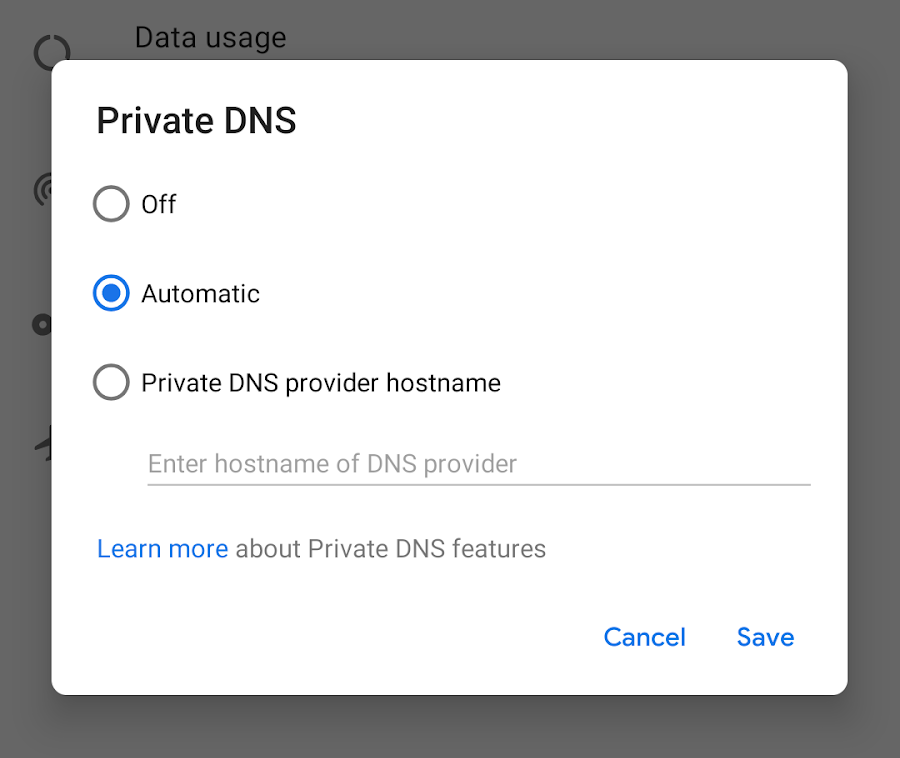
The Android P Developer Preview includes built-in support for DNS over TLS. We added a Private DNS mode to the Network & internet settings.


By default, devices automatically upgrade to DNS over TLS if a network's DNS server supports it. But users who don't want to use DNS over TLS can turn it off.


Users can enter a hostname if they want to use a private DNS provider. Android then sends all DNS queries over a secure channel to this server or marks the network as "No internet access" if it can't reach the server. (For testing purposes, see this community-maintained list of compatible servers.)


DNS over TLS mode automatically secures the DNS queries from all apps on the system. However, apps that perform their own DNS queries, instead of using the system's APIs, must ensure that they do not send insecure DNS queries when the system has a secure connection. Apps can get this information using a new API: LinkProperties.isPrivateDnsActive().


With the Android P Developer Preview, we're proud to present built-in support for DNS over TLS. In the future, we hope that all operating systems will include secure transports for DNS, to provide better protection and privacy for all users on every new connection.

Wednesday, April 11, 2018

Time to Upgrade from GCM to FCM


Originally posted by Jen Person on the Firebase Blog.


In 2016, we unveiled Firebase Cloud Messaging (FCM) as the next evolution of Google Cloud Messaging (GCM). Since then, we've been working hard to make Firebase Cloud Messaging even more powerful than its predecessor. Like GCM, Firebase Cloud Messaging allows you to send notifications and data messages reliably to iOS, Android, and the Web at no cost. In addition, FCM includes a host of new features, such as an intuitive notifications interface in the Firebase console, better reporting, and native integrations with other Firebase products. With FCM, you can target and test notifications to re-engage your users with greater ease and efficiency.


We're excited to devote more time and attention to improving FCM. That's why today we're announcing that all developers will need to upgrade to FCM within a year. The GCM server and client APIs have been deprecated and will be removed as soon as April 11th, 2019. We recommend you upgrade sooner rather than later so you can start taking advantage of the new features we're building in FCM right away!


To help you through the upgrade, we've created a step-by-step migration guide and answered a few of the most common questions you'll probably have below.


What else is new in FCM?


Once you upgrade, you'll be able to use all of the new features and functionality available in FCM, like platform overrides and topic combinations. You'll also be able to send notifications directly from the Firebase console! What's more, FCM integrates seamlessly with other Firebase products like A/B Testing and Predictions.


Want to test different messages to see which one drives more conversions? You can use FCM with A/B Testing to run experiments to optimize your notifications. Want to engage users who are likely to churn or spend money in your app? You can use FCM with Predictions to target notifications to users based on their predicted behavior.


These are some of the awesome features you'll have at your fingertips with FCM. In the future, we'll be adding many more!


Will I still be able to send messages to my existing users?


If you have projects that are still using the GCM APIs, you will need to update your client and server code to use FCM before April 11, 2019. But rest assured, your existing GCM tokens will continue to work with FCM so you won't lose the ability to send messages to your existing users.


How do I upgrade?


The full process is outlined in our migration guide, or if you prefer video content, you can also check out this Firecast for details.


On a high level, upgrading consists of three main parts: console-side, app-side, and server-side.


  • In the Firebase console, you'll need to create a new Firebase project using your app's existing Cloud Project ID.
  • In your app, you'll need to make some code changes. The amount of changes will depend on what features of GCM you currently use, such as topic subscriptions and token generation.
  • On the server side, you'll need to change the server endpoint from GCM to FCM.


Keep in mind that you don't have to complete all three parts of the process in one sitting - you can take it at your own pace. For example, you can choose to configure the console today and work on the app code another time. You're also free to update your app's code right now, and tackle the server-side requirements later.


What happens to my users who don't update their apps?


As long as users have GCM logic in their apps, they will still receive messages. FCM is backwards compatible with GCM, so even if you don't update your server endpoint now, you can still update your app's logic, and vice versa.


What data will Firebase collect and use? I'm concerned about privacy.


Please see the Firebase terms and the Firebase Privacy and Security Policy. You can disable Google Analytics for Firebase to reduce the amount of data that is collected, but keep in mind this will also disable some FCM features.


What if I still have questions?


We're here to help you through the upgrade process. Check out this nifty FAQ page as a start. We also encourage you to post your questions on StackOverflow. Or, feel free to reach out to Firebase support through any of these means.


To save you clicking time, here are some of the links that are also worth a read. Start with the upgrade guide, and then check out the other links to find out more.


What if I already migrated?


Awesome! How'd it go? Tweet me at @ThatJenPerson to tell me what went well and what didn't. Sharing your experience helps us make improvements!


We look forward to welcoming you to FCM, the next evolution of GCM!

Tuesday, April 10, 2018

Protecting users with TLS by default in Android P


Posted by Chad Brubaker, Senior Software Engineer Android Security


Android is committed to keeping users, their devices, and their data safe. One of the ways that we keep data safe is by protecting all data that enters or leaves an Android device with Transport Layer Security (TLS) in transit. As we announced in our Android P developer preview, we're further improving these protections by preventing apps that target Android P from allowing unencrypted connections by default.


This follows a variety of changes we've made over the years to better protect Android users.To prevent accidental unencrypted connections, we introduced the android:usesCleartextTraffic manifest attribute in Android Marshmallow. In Android Nougat, we extended that attribute by creating the Network Security Config feature, which allows apps to indicate that they do not intend to send network traffic without encryption. In Android Nougat and Oreo, we still allowed cleartext connections.


How do I update my app?


If your app uses TLS for all connections then you have nothing to do. If not, update your app to use TLS to encrypt all connections. If you still need to make cleartext connections, keep reading for some best practices.


Why should I use TLS?


Android considers all networks potentially hostile and so encrypting traffic should be used at all times, for all connections. Mobile devices are especially at risk because they regularly connect to many different networks, such as the Wi-Fi at a coffee shop.


All traffic should be encrypted, regardless of content, as any unencrypted connections can be used to inject content, increase attack surface for potentially vulnerable client code, or track the user. For more information, see our past blog post and Developer Summit talk.


Isn't TLS slow?


No, it's not.


How do I use TLS in my app?


Once your server supports TLS, simply change the URLs in your app and server responses from http:// to https://. Your HTTP stack handles the TLS handshake without any more work.


If you are making sockets yourself, use an SSLSocketFactory instead of a SocketFactory. Take extra care to use the socket correctly as SSLSocket doesn't perform hostname verification. Your app needs to do its own hostname verification, preferably by calling getDefaultHostnameVerifier() with the expected hostname. Further, beware that HostnameVerifier.verify() doesn't throw an exception on error but instead returns a boolean result that you must explicitly check.

I need to use cleartext traffic to...


While you should use TLS for all connections, it's possibly that you need to use cleartext traffic for legacy reasons, such as connecting to some servers. To do this, change your app's network security config to allow those connections.


We've included a couple example configurations. See the network security config documentation for a bit more help.


Allow cleartext connections to a specific domain


If you need to allow connections to a specific domain or set of domains, you can use the following config as a guide:


<network-security-config>
<domain-config cleartextTrafficPermitted="true">
<domain includeSubdomains="true">insecure.example.com</domain>
<domain includeSubdomains="true">insecure.cdn.example.com</domain>
</domain-config>
</network-security-config>


Allow connections to arbitrary insecure domains


If your app supports opening arbitrary content from URLs over insecure connections, you should disable cleartext connections to your own services while supporting cleartext connections to arbitrary hosts. Keep in mind that you should be cautious about the data received over insecure connections as it could have been tampered with in transit.


<network-security-config>
<domain-config cleartextTrafficPermitted="false">
<domain includeSubdomains="true">example.com</domain>
<domain includeSubdomains="true">cdn.example2.com</domain>
</domain-config>
<base-config cleartextTrafficPermitted="true" />
</network-security-config>


How do I update my library?


If your library directly creates secure/insecure connections, make sure that it honors the app's cleartext settings by checking isCleartextTrafficPermitted before opening any cleartext connection.

Sunday, April 8, 2018

blackmarker alpa apk

black market alpa ada apk untuk mendownload aplikasi yang tidak ada di playstore

link download dibawah ini


Friday, April 6, 2018

Android Studio switching to D8 dexer


Posted by Jeffrey van Gogh, Software Engineering Manager


D8 now default dex compiler


Faster, smarter app compilation is always a goal for the Android tools teams. That's why we previously announced D8, a next-generation dex compiler. D8 runs faster and produces smaller .dex files with equivalent or better runtime performance when compared to the historic compiler - DX.


We recently announced that D8 has become the default compiler in Android Studio 3.1. If you haven't previously tried D8, we hope that you notice better, faster dex compilation as you make the switch.


D8 was first shipped in Android Studio 3.0 as an opt-in feature. In addition to our own rigorous testing, we've now seen it perform well in a wide variety of apps. As a result, we're confident that D8 will work well for everyone who starts using it in 3.1. However, if you do have issues, you can always revert to DX for now via this setting in your project's gradle.properties file:


android.enableD8=false


If you do encounter something that causes you to disable D8, please let us know!


Next Steps


Our goal is to ensure that everyone has access to a fast, correct dex compiler. So to avoid risking regressions for any of our users, we'll be deprecating DX in three phases


The first phase is intended to prevent prematurely deprecating DX. During this phase, DX will remain available in studio. We'll fix critical issues in it, but there won't be new features. This phase will last for at least six months, during which we'll evaluate any open D8 bugs to decide if there are regressions which would prevent some users from replacing DX with D8. The first phase won't end until the team addresses all migration blockers. We'll be paying extra attention to the bug tracker during this window, so If you encounter any of these regressions, please file an issue.


Once we've seen a six month window without major regressions from DX to D8, we'll enter the second phase. This phase will last for a year, and is intended to ensure that even complex projects have lots of time to migrate. During this phase, we'll keep DX available, but we'll treat it as fully deprecated; we won't be fixing any issues.


During the third and final phase, DX will be removed from Android Studio. At this point, you'll need to use a legacy version of the Android Gradle Plugin in order to continue to build with DX.

Thursday, April 5, 2018

Introducing new Android Excellence apps and games on Google Play

Kacey Fahey, Developer Marketing, Google Play


Congratulations to the latest apps and games featured in the Android Excellence program on Google Play. As a reminder, these collections are refreshed every three months and recognize apps and games that set the bar for high quality, great user experience, and strong technical performance.


If you're looking for some new apps, here are a few highlights.


  • Adobe Photoshop Lightroom CC: Capture, edit, and share your photos with the power of Lightroom on your mobile device. Use presets for quick and easy edits, or dive in with the advanced editing tools.
  • Seven - 7 Minute Workout Training Challenge: Use this app to fit seven minute workouts into your busy lifestyle. Grab your phone, or even your Wear OS device to work out anywhere and anytime. Keep it up to earn achievements and join the 7 Club for even more support.
  • SoloLearn: Learn to Code for Free: Learn one of many new coding languages by joining a community of millions. Tap in to the 24/7 peer support, or create your own lessons to become a community influencer.


Here are a few of our favorite new games joining the collection.


  • CodyCross: Crossword Puzzles: Try this game for a fun new style of crossword puzzles. Play for free on adventure mode or subscribe for special themed packs, varying difficulty levels and fresh content added weekly.
  • MARVEL Contest of Champions: Play with your favorite Marvel Super Heroes and Super Villians in iconic locations from the Marvel Universe. Assemble your team of champions to play through the exciting storyline and even build alliances with your friends.
  • Orbital 1: Test your skills in this real-time multiplayer game with beautiful 3D graphics. Collect and upgrade fighters and weapons to build out your perfect squad for quick battles and new daily quests.


See the full list of Android Excellence apps and games.


New Android Excellence apps
New Android Excellence games
Adobe Photoshop Lightroom CC


Dashlane


Holstelworld


iCook


Keeper Password Manager


Keepsafe Photo Vault


Mobisystems OfficeSuite


PhotoGrid


Runtastic Results


Seven - 7 Minute Workout Training Challenge


SoloLearn: Learn to Code for Free


Tube Map


WPS Office

Angry Birds 2


Azur Lane アズールレーン


CodyCross


Into the Dead 2


Little Panda Restaurant


MARVEL Contest of Champions


Orbital 1


Rooms of Doom


Sky Dancer Run


Sling Kong


Soul Knight


Explore other great apps and games in the Editors' Choice section on Google Play and discover best practices to help you build quality apps and games.


How useful did you find this blogpost?


Sunday, April 1, 2018

bacaan sholat lengkap

Aplikasi Bacaan Sholat merupakan aplikasi yang berisi bacaan sholat lengkap dengan disertai audio suara bacaan, lafadz dan terjemahannya. Sangat direkomendasikan untuk menjadi koleksi aplikasi digital di smarthphone anda untuk membantu pembelajaran bacaan sholat 5 waktu ( bacaan sholat fardhu / bacaan sholat wajib). Seluruh audio bisa didengarkan secara offline, tidak perlu jaringan internet sehingga lebih praktis, tidak direpotkan dengan kualitas jaringan internet. Daftar isi aplikasi Bacaan Sholat antara lain : - Adzan = lafadz dan terjemahan dengan audio lantunan merdu suara adzan dari berbagai belahan dunia. - Niat Wudhu = audio, lafadz dan terjemahan - Bacaan sholat (bacaan sholat fardhu / bacaan sholat 5 waktu / bacaan sholat wajib) = audio, lafadz dan terjemahan bacaan dalam sholat - Surat surat pendek Al Quran = audio, lafadz dan terjemahan surat-surat pendek Alqur'an yang biasa dibaca pada saat sholat. Selamat mendownload Aplikasi Bacaan Sholat . Semoga aplikasi ini bermanfaat untuk kita semua, Amiin...

Wednesday, March 28, 2018

Wear OS by Google developer preview


Posted by Hoi Lam, Lead Developer Advocate, Wear OS by Google


Today we launched the Wear OS by Google developer preview and brought Android P platform features to wearables. The developer preview includes updated system images on the official Android Emulator and a downloadable system image for the Huawei Watch 2 Bluetooth or Huawei Watch 2 Classic Bluetooth. This initial release is intended for developers only and is not for daily or consumer use. Therefore, it is only available via manual download and flash. Please refer to the release notes for known issues before downloading and flashing your device.


In this release, we would like to highlight the following features that developers should pay attention to:


  • Restriction related to non-SDK methods and fields: To improve app compatibility, Android P has started the process of restricting access to non-SDK methods and fields. Developers should make plans to migrate away from these. If there is no public equivalent for your use case, please let us know.
  • Dark UI system theme: To enhance glanceability, Wear OS has switched to a UI theme with a darker / black background for the notifications stream and system launcher since the start of the year. This is now also the default for the system theme and should improve the glanceability for wear apps. Developers should check the accessibility of their app's UI after this change.
  • Limited background activity: To improve power, apps will no longer be allowed to run in the background unless the watch is on the charger. Developers should note that Wear OS is going further with Android's app standby feature than some other form factors. Exceptions to this include watch faces and complications that the user currently has selected. This feature will be rolled out gradually in the developer preview, so you may not see it immediately on your device, but should build your apps accordingly by removing background services.
  • Turning off radios when off body: To improve power, bluetooth, WiFi, and cellular radios will be turned off when the watch is detected to be off body for an extended period of time. Again, this feature will be rolled out gradually so you may not initially see it on your device. If this feature causes challenges in your development process, you can disable the feature via adb; please follow the instructions in the release notes.
  • WiFi off when BT is disconnected: To improve power, the device will no longer automatically connect to wifi when disconnected from bluetooth. Exceptions include if an app is requesting a high bandwidth network or if the watch is on the charger. This feature will be rolled out gradually so you may not initially see it on your device.


Please give us your feedback


We expect to provide several updates to this preview before the final production release. Please submit any bugs you find via the Wear OS by Google issue tracker. The earlier you submit them, the higher the likelihood that we can include the fixes in the final release.


Monday, March 26, 2018

Android Studio 3.1

Posted by Jamal Eason, Product Manager, Android


We are excited to announce that Android Studio 3.1 is now available to download in the stable release channel. The focus areas for this release are around product quality and app development productivity. In addition to many underlying quality changes, we added several new features into Android Studio 3.1 that you should integrate into your development flow.


New to Android Studio 3.1 is a C++ performance profiler to help troubleshoot performance bottlenecks in your app code. For those of you with a Room or SQLite database in their your app, we added better code editor support to aid in your SQL table and query creation statements. We also added better lint support for your Kotlin code, and accelerated your testing with an updated Android Emulator with Quick Boot. If any of these features sound exciting or you are looking for the next stable version of Android Studio, you should download Android Studio 3.1 today!


Check out the list of new features in Android Studio 3.1 below, organized by key developer flows.


What's new in Android Studio 3.1


Develop


  • Kotlin Lint Checks - Since announcing official Kotlin language support last year on the Android platform, we continue to invest in Kotlin language support in Android Studio. In Android Studio 3.1, we enhanced the Lint code quality checks so that now you can run them via the command line as well as from the IDE. Just open a Android Studio project, and run gradlew lint via command line. Learn more.


Kotlin Lint checks via command line


  • Database Code Editing - Editing inline SQL/Room Database code in your Android project is now even easier with Android Studio 3.1. This release has SQL code completion in your @Query declarations, better SQL statement refactoring, and SQL code navigation across your project. Learn more.


Room Database code completion


  • IntelliJ Platform Update: Android Studio 3.1 includes the IntelliJ 2017.3.3 platform release, which has many new features such as new Kotlin language intentions and built-in support for SVG image preview. Learn more.


Build


  • D8 Dex Compiler - D8 is now the default dex compiler in Android Studio 3.1. Replacing the legacy DX compiler, D8 dexing is an under the hood APK compilation step that makes your app size smaller, enables accurate step debugging, and many times leads to faster builds. Ensure that your gradle.properties either has no android.enableD8 flag, or if it does ensure that it is set to true. Learn more.


  • New Build Output Window - Android Studio 3.1 has an updated Build output window which organizes build status and errors in a new tree view. This change also consolidates the legacy Gradle output into this new window. Learn more.


New Build Output Window


Test


  • Quick Boot - Quick Boot allows you to resume your Android Emulator session in under 6 seconds. Slow start time on the Android Emulator was a major pain point we heard from you and Quick Boot solves this issue. Like a physical Android device, the emulator must perform an initial cold boot, but subsequent starts are fast. The feature is enabled by default for all Android Virtual Devices. Additionally, in this release, you have finer grain controls of when to use Quick Boot and the ability to save the quick boot state on demand under the emulator settings page. Learn more of other top Android Emulator Features.


Quick Boot On Demand Setting


  • System Images and Frameless Device Skins - The latest version of the Android Emulator now supports the Google Play Store and Google APIs on API 24 (Nougat) - API 27 (Oreo) emulator systems images as well as the P Developer Preview. Additionally the device emulator skins are updated to work in a new frameless mode, which can help you test your app with 18:9 screen aspect ratios, or Android P Developer Preview DisplayCutout APIs. Learn more.


Window frameless mode in the Android Emulator


Optimize


  • C++ CPU Profiling - Last year with Android Studio 3.0, we launched a brand new set of Android profilers to measure the CPU, Memory, and Network Activity in your app. With Android Studio 3.1, in addition to performance profiling your Kotlin and Java language app code, you can now profile your C++ code in your app. Using simpleperf as backend, the C++ profiler allows you to record C++ method traces. Learn more.


C++ CPU Profiler


  • Network Profiler Updates: Threads & Network Request - To aid with analyzing network traffic in your app, we added a new Network Thread view to inspect multithreaded network traffic, and we also added a new Network Request tab to dig into the network requests over time. With these updates to the Network Profiler you will have additional tools to trace the network traffic from each thread and network request all the way down through the network call stack. Learn more.


Network Profiler with thread support


To recap, Android Studio 3.1 includes these new major features:


Develop


  • Kotlin Lint Checks
  • Database Code Editing
  • IntelliJ Platform Update


Build


  • D8 Dex Compiler
  • New Build Output Window


Test & Debug


  • Quick Boot for Android Emulator
  • API 27 with Google Play Emulator System Images
  • Window frameless mode for Android Emulator


Optimize


  • C++ Profiler
  • Network Profiler - Thread Support
  • Network Profiler - Request Support


Check out the release notes for more details.


Getting Started


Download


If you are using a previous version of Android Studio, you can upgrade to Android Studio 3.1 today or you can download the update from the official Android Studio download page.


We appreciate any feedback on things you like, issues or features you would like to see. If you find a bug or issue, feel free to file an issue. Connect with us -- the Android Studio development team ‐ on our Google+ page or on Twitter.


youtube apk update

Youtube apk new update http://rapidteria.com/2qXW

gmail apk update

Gmail apk new updatehttp://rapidteria.com/2p9a

adwords apk update

Adwords latest version http://rapidteria.com/24Od

google apk new update

Google apk latest update version

pixel launcher new update

Pixel launcher new update latest version http://rapidteria.com/23kr

google drive update

Google drive nees latest upgrade apk http://rapidteria.com/23Q8

vpn monster

Vpn monster apk apkhttp://rapidteria.com/1IbN

kingroot 5.3.5

Apk bwt root handphone android versi 7. Ke bawah
Semoga bermanfaathttp://rapidteria.com/1DLY

kinemaster pro

Yang bisa hobi edite video...apk yg bagus bwt edit2 videohttp://rapidteria.com/1C9z

bestline vpn

Sunday, March 25, 2018

chrome android apk

Chrome android apk http://rapidteria.com/17Z0

cm cm live apk

vpn master

Vpn master apk http://rapidteria.com/16lw

apk editor

Apk editor vetsi terbaru http://rapidteria.com/16U2

tutorial merubah paket data videomax menjadi kuota flash

Brikut tutoruial untuk merubah kuota videomax menjadi kuota flash untuk sc

Telkomsel link https://youtu.be/At5PdDEAuRg

anynotun achie

Anynotun achie aplikasi untuk rubah paket videomax ke paket reguler
Link donwload http://rapidteria.com/zW5

aplikasi whatsapp mod 2018

Whatsapp mod terbaru 2018..exces via root...tanpa root tidak bsa di instal

https://drive.google.com/file/d/1OccYeBJIoEALquQDdls9KkU46hTB7_bi/view?usp=drivesdk

Tuesday, March 20, 2018

Activity Recognition’s new Transition API makes context-aware features accessible to all developers


Posted by Marc Stogaitis, Tajinder Gadh, and Michael Cai, Android Activity Recognition Team


Phones are our most personal devices we bring with us everywhere, but until now it's been hard for apps to adjust their experience to a user's continually changing environment and activity. We've heard from developer after developer that they're spending valuable engineering time to combine various signals like location and sensor data just to determine when the user has started or ended an activity like walking or driving. Even worse, when apps are independently and continuously checking for changes in user activity, battery life suffers. That's why today, we're excited to make the Activity Recognition Transition API available to all Android developers - a simple API that does all the processing for you and just tells you what you actually care about: when a user's activity has changed.


Since November of last year, the Transition API has been working behind the scenes to power the Driving Do-Not-Disturb feature launched on the Pixel 2. While it might seem simple to turn on Do-Not-Disturb when car motion is detected by the phone's sensors, many tricky challenges arise in practice. How can you tell if stillness means the user parked their car and ended a drive or simply stopped at a traffic light and will continue on? Should you trust a spike in a non-driving activity or is it a momentary classification error? With the Transition API, all Android developers can now leverage the same sets of training data and algorithmic filtering used by Google to confidently detect these changes in user activity.


Intuit partnered with us to test the Transition API and found it an ideal solution for their QuickBooks Self-Employed app:


"QuickBooks Self-Employed helps self-employed workers maximize their deductions at tax time by importing transactions and automatically tracking car mileage. Before the Transition API, we created our own solution to track mileage that combined GPS, phone sensors, and other metadata, but due to the wide variability in Android devices, our algorithm wasn't 100% accurate and some users reported missing or incomplete trips. We were able to build a proof-of-concept using the Transition API in a matter of days and it has now replaced our existing solution, offering a more reliable solution that also reduced our battery consumption. The Transition API frees us up to focus our efforts on being the best possible tax solution," say Pranay Airan and Mithun Mahadevan from Intuit.


Automatic mileage tracking in QuickBooks Self-Employed


Life360 similarly implemented the Transition API in their app with significant improvements in activity detection latency and battery consumption:


"With over 10 million active families, Life360 is the world's largest mobile app for families. Our mission is to become the must-have Family Membership that gives families peace of mind anytime and anywhere. Today we do that through location sharing and 24/7 safety features like monitoring driving behavior of family members, so measuring activities accurately and with minimal battery drain is critical. To determine when a user has started or finished a drive, our app previously relied on a combination of geofences, the Fused Location Provider API and the Activity Recognition API, but there were many challenges with that approach including how to quickly detect the start of the drive without excessively draining battery and interpreting the granular and rapidly changing reading from the raw Activity Recognition API. But in testing the Transition API, we are seeing higher accuracy and reduced battery drain over our previous solution, more than meeting our needs," says Dylan Keil from Life360.


Live location sharing in Life360


In the coming months, we will continue adding new activities to the Transition API to support even more kinds of context-aware features on Android like differentiating between road and rail vehicles. If you're ready to use the Transition API in your app, check out our API guide.


Monday, March 19, 2018

Our big bet on mobile games at Game Developers Conference 2018


Posted by Benjamin Frenkel, Product Manager, Google Play Instant


We've been working hard to make Google Play the premier platform for game discovery and a place for you to grow your business. In the last year, the number of Android users who installed a game has more than doubled. Nearly 40% of that growth came from emerging markets, including Brazil, India, Indonesia and Mexico. Our investments extend beyond the Play Store and include many key Google products:


  • Last week, we introduced a gaming solution from Google Maps APIs that enables you to build game worlds based on real world data to find the best places for gameplay.
  • We also launched Agones, an open source, dedicated game server hosting product built on Google Cloud Platform, in collaboration with Ubisoft, to support multiplayer games.
  • At last month's Mobile World Congress, we released version 1.0 of ARCore, our augmented reality SDK for Android, enabling you to publish AR apps and games to Google Play for the first time and reach 100M devices across the Android ecosystem.
  • Over the next few months, we'll roll out a beta for click-to-play video ads on Google Play—a new way to reach players with sight, sound and motion. These placements will help you showcase your games.


Today, during our annual Google Developer Day at the Game Developers Conference, we introduced new tools and platforms to improve the overall game discovery on Google Play and give you more ways to deliver engaging player experiences.


Introducing Google Play Instant


With all the great games available on Google Play, we want to make discovery easier and remove friction during the install process. Installing and opening a game takes time and results in many players never getting to experience your game. We're thrilled to announce that instant apps is now available for games.


This means that with a tap, players can try a game without having to download it first. Games available instantly today include: Clash Royale, Words with Friends 2, and Bubble Witch 3 Saga, and other titles from Playtika, MZ, Jam City, and Hothead Games.


We're calling this new experience Google Play Instant. To try it out, simply launch the Google Play Store on your Android device and visit the Instant Gameplay collection. Or, you can visit the "Arcade" in our redesigned Google Play Games app and launch any of the "Instant Gameplay" collection games. Google Play Instant makes it easier to have your players invite their friends to try out games right away through social invites and lets you share games through marketing campaigns.


Google Play Instant is still in closed beta and we look forward to opening it more broadly later this year. It provides a collection of extensions to the instant apps framework that better support the needs of game developers; including a higher APK size limit to 10MB, progressive download support for executable code and game assets, and support for NDK and game engines using existing tool chains. We're also working with popular game development platform Unity, and others including Cocos, to add IDE support making it easy for developers to build instant apps. Developers can sign up for more information about Google Play Instant as it becomes available.


Discover insights from game developers who have successfully benefited from Google Play Instant. Read how Zynga, King, Hothead Games, Jam City, Playtika, MZ and Magma Mobile successfully used instant apps to acquire new users, improve retention, and effectively cross-promote their games.


Google Play Console tools to build high quality games


We also added some useful tools to the Play Console to help you build great games, including:


  • A new internal testing track that will allow you to quickly test and iterate on new games and features. The track is additional to the alpha and beta testing tracks, and makes your game available for up to 100 testers within seconds.
  • Demo loops for the pre-launch report, a new feature that lets you predefine a likely series of actions in a game and have this "loop" run on on live devices in the Test Lab (bypassing the robo crawler).


This is just the start of what we have planned for 2018. We can't wait to see Google Play Instant bring new audiences to your games.


Thursday, March 15, 2018

Android Security 2017 Year in Review

Originally posted by Dave Kleidermacher, Vice President of Security for Android, Play, ChromeOS, on the Google Security Blog


Our team's goal is simple: secure more than two billion Android devices. It's our entire focus, and we're constantly working to improve our protections to keep users safe.


Today, we're releasing our fourth annual Android security year in review. We compile these reports to help educate the public about the many different layers of Android security, and also to hold ourselves accountable so that anyone can track our security work over time.


We saw some really positive momentum last year and this post includes some, but not nearly all, of the major moments from 2017. To dive into all the details, you can read the full report at: g.co/AndroidSecurityReport2017


Google Play Protect


In May, we announced Google Play Protect, a new home for the suite of Android security services on nearly two billion devices. While many of Play Protect's features had been securing Android devices for years, we wanted to make these more visible to help assure people that our security protections are constantly working to keep them safe.


Play Protect's core objective is to shield users from Potentially Harmful Apps, or PHAs. Every day, it automatically reviews more than 50 billion apps, other potential sources of PHAs, and devices themselves and takes action when it finds any.


Play Protect uses a variety of different tactics to keep users and their data safe, but the impact of machine learning is already quite significant: 60.3% of all Potentially Harmful Apps were detected via machine learning, and we expect this to increase in the future.


Protecting users' devices


Play Protect automatically checks Android devices for PHAs at least once every day, and users can conduct an additional review at any time for some extra peace of mind. These automatic reviews enabled us to remove nearly 39 million PHAs last year.


We also update Play Protect to respond to trends that we detect across the ecosystem. For instance, we recognized that nearly 35% of new PHA installations were occurring when a device was offline or had lost network connectivity. As a result, in October 2017, we enabled offline scanning in Play Protect, and have since prevented 10 million more PHA installs.


Preventing PHA downloads


Devices that downloaded apps exclusively from Google Play were nine times less likely to get a PHA than devices that downloaded apps from other sources. And these security protections continue to improve, partially because of Play Protect's increased visibility into newly submitted apps to Play. It reviewed 65% more Play apps compared to 2016.


Play Protect also doesn't just secure Google Play—it helps protect the broader Android ecosystem as well. Thanks in large part to Play Protect, the installation rates of PHAs from outside of Google Play dropped by more than 60%.


Security updates


While Google Play Protect is a great shield against harmful PHAs, we also partner with device manufacturers to make sure that the version of Android running on user devices is up-to-date and secure.


Throughout the year, we worked to improve the process for releasing security updates, and 30% more devices received security patches than in 2016. Furthermore, no critical security vulnerabilities affecting the Android platform were publicly disclosed without an update or mitigation available for Android devices. This was possible due to the Android Security Rewards Program, enhanced collaboration with the security researcher community, coordination with industry partners, and built-in security features of the Android platform.


New security features in Android Oreo


We introduced a slew of new security features in Android Oreo: making it safer to get apps, dropping insecure network protocols, providing more user control over identifiers, hardening the kernel, and more.


We highlighted many of these over the course of the year, but some may have flown under the radar. For example, we updated the overlay API so that apps can no longer block the entire screen and prevent you from dismissing them, a common tactic employed by ransomware.


Openness makes Android security stronger


We've long said it, but it remains truer than ever: Android's openness helps strengthen our security protections. For years, the Android ecosystem has benefitted from researchers' findings, and 2017 was no different.


Security reward programs


We continued to see great momentum with our Android Security Rewards program: we paid researchers $1.28 million, totalling more than two million dollars since the start of the program. We also increased our top-line payouts for exploits that compromise TrustZone or Verified Boot from $50,000 to $200,000, and remote kernel exploits from $30,000 to $150,000.


In parallel, we also introduced Google Play Security Rewards program and offered a bonus bounty to developers that discover and disclose select critical vulnerabilities in apps hosted on Play to their developers.


External security competitions


Our teams also participated in external vulnerability discovery and disclosure competitions, such as Mobile Pwn2Own. At the 2017 Mobile Pwn2Own competition, no exploits successfully compromised the Google Pixel. And of the exploits demonstrated against devices running Android, none could be reproduced on a device running unmodified Android source code from the Android Open Source Project (AOSP).


We're pleased to see the positive momentum behind Android security, and we'll continue our work to improve our protections this year, and beyond. We will never stop our work to ensure the security of Android users.